Western Fire Season Brief (2016-2020)
Data is courtesy of the Canadian Interagency Forest Fire Centre (CIFFC), which was established in 1982 and includes the Provincial, Territorial and Federal (Parks Canada and the Canadian Forest Service) agencies responsible for wildfire management in Canada. This non-profit corporation was created to formalize the sharing of resources and information amongst the fire management agencies across the country to facilitate national wildland fire preparedness, safety, and response capability. The CIFFC put out Canada Reports annually that provide a synopsis of the fire season and statistics. This blog post features select information from the official reports (2016-2020) as it pertains to the Western Canada provinces. To view the reports in full, please visit the Canada Reports section on the CIFFC website.
Summary of the five year trend
2020
As of December 31st, 2020, Canadian Fire Management Agencies recorded 3,916 fires with an area consumed of 227,389 hectares. The 2020 Fire Season will go down as one of the most memorable on record even though it was a relatively quiet season across Canada. Nationally, the number of fire starts were down 32% from the 10-year average and the total area burned in Canada was down 92% from the 10-year average. It was also the first time in over 10 years that the National Preparedness Level did not reach higher than NPL 2 during the entire fire season. The slower than normal domestic fire season, however, was book ended by busy periods before and after as Canada provided international support to Australia during the January to March period and to the Northwestern United States in September and October. There were no reported wildfire-related fatalities.
-
The 2020 wildfire season in British Columbia was quieter than anticipated. The COVID-19 pandemic made firefighting in B.C. challenging, but safety measures introduced early in the season minimized the risk of exposure while also ensuring an effective emergency response. In the fall of 2020, the BC Wildfire Service responded to three requests for assistance from the United States via the Canadian Interagency Forest Fire Centre. In total, 430 personnel were deployed (224 to California and 206 to Oregon) to support firefighting efforts during the extreme wildfire season in the western United States.
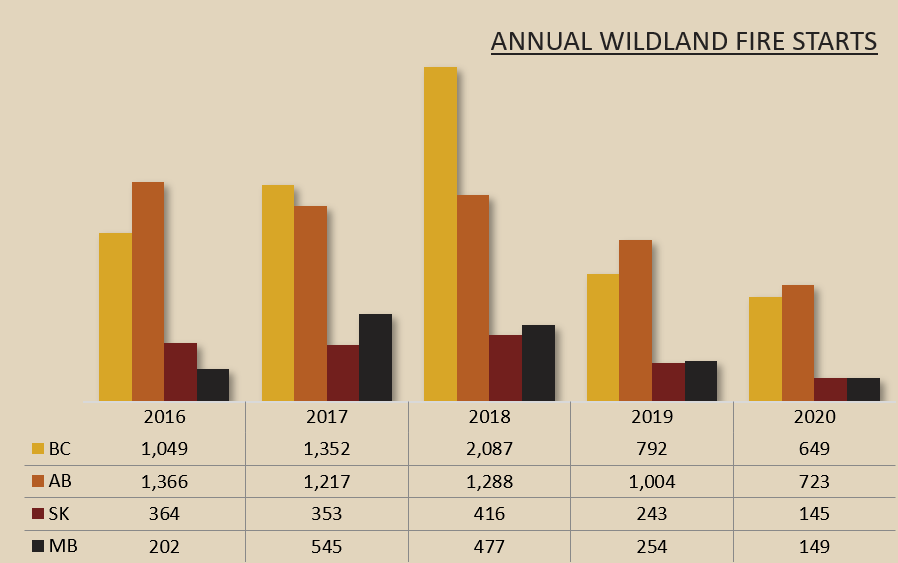
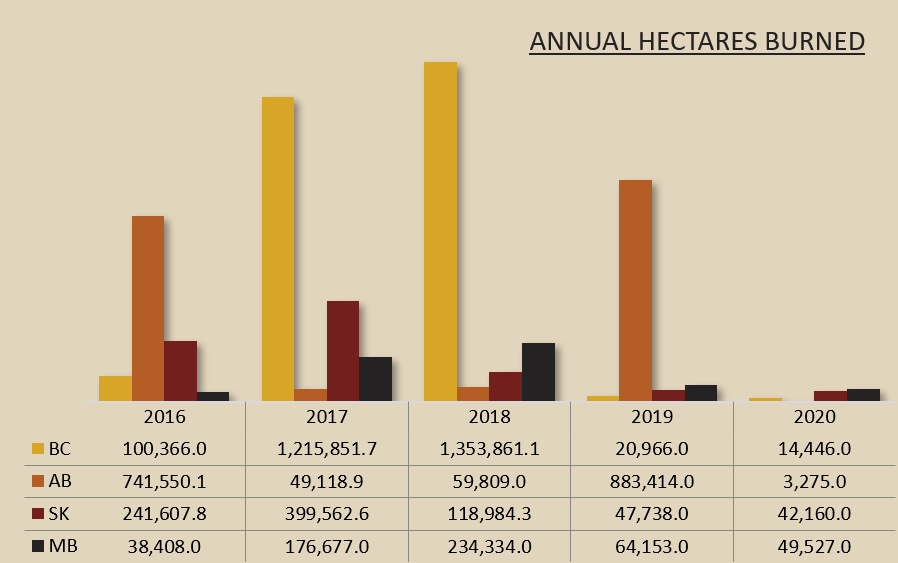
The 2020 wildfire season in British Columbia saw 649 wildfires burning 15,491 hectares of land between April 1 and Oct. 1, 2020. This is down from the 10-year average of 1,356 wildfires and 347,104 hectares that typically burn over a full fire season.
-
Alberta experienced a relatively quiet 2020 wildfire season thanks to the diligence of Albertans, effective departmental preparations, and substantial precipitation in many areas of the province. Alberta exported 61 firefighters and support staff to Quebec, 3 to the Northwest Territories, and 44 to Oregon to assist with their wildfire operations. Following the direction of Alberta Health Services, Alberta Wildfire quickly adapted to the demands of fighting wildfires during a pandemic, making important and necessary changes to daily routines to ensure the safety of all involved. Changes included introducing quarantine procedures for firefighters exported to the U.S. There were no confirmed cases of COVID-19 among Alberta firefighters during the 2020 wildfire season.
The 2020 wildfire season saw 704 wildfires burning just over 3,269 hectares, only 0.8 per cent of total area burned in comparison to the five-year average. Eighty-eight per cent of the wildfires were human caused; however, this number has been declining over the past five years due to prevention programs. Later, the final numbers put Alberta at 723 wildfires with 3,275 hectares burnt.
-
Saskatchewan had a very quiet wildfire season in 2020 due to weather systems which brought significant precipitation during the summer months, as well as above normal late spring runoffs which contributed to many areas with localized flooding. Due to the slower than usual fire season, Saskatchewan requested no out of province imports. Exports included equipment sent to aid Quebec, a three-personnel export to assist Australia, and two aircraft exports to the United States. There were no quick strikes performed out of Saskatchewan in 2020.
Saskatchewan had a total of 145 wildfires in 2020 – this is well below the 5-year average of 303. Human caused fires accounted for 123 fires and lightning was responsible for the remaining 22 fires. The total provincial area burned by wildfires was 42,160 hectares. The total hectares for the 2020 fire season are approximately 10.89 percent of the ten-year average of 387,099.3 hectares.
-
The Province of Manitoba experienced a well below average wildfire season in 2020. There were three fires of note: Field Lake south of Bissett, Pulp River Complex in the Camperville area and Beaver Creek provincial park near Hecla in the Interlake that resulted in structure loss. The major challenge of 2020 was and will remain to be Coronavirus that affects all aspects of wildfire management, business, response, and operations. Planning, preparedness, and protection continues to be a very high priority.
The 2020 wildfire season in Manitoba saw a total of 149 fires burning, with 69 of those reportedly caused by lightning and 80 being human-related. These wildfires resulted in 49,527 hectares burnt.
2019
As of December 31, 2019 Canadian Fire Management Agencies recorded 3933 fires with an area consumed of 1,787,792 hectares. Spring came early to Alberta with significant warm weather in March knocking down the snowpack. By May, they had 3 priority fires under a “very high” to “extreme” fire hazard, with the fire load and fire hazard expected to increase, prompting other provinces, including British Columbia, New Brunswick, Ontario, Nova Scotia, Quebec, and Prince Edward Island to send crews to help with suppression and mobilization. Yukon also requested support with fire management staff and overhead from Ontario arriving at the end of May. By June Alberta had added another priority fire, while BC and Ontario were experiencing their own fires and escalated activity. Throughout the month of June, resources continued to pour onto Alberta from all cross the country and international allies. Although still requiring significant assistance, AB’s resource requirements slowly began to ease off at the end of June. Meanwhile alongside Alberta, the fire activity in Yukon, Manitoba and Ontario was ramping up, requiring the mobilization of resources from other Canadian agencies, with crews from the other provinces present throughout July. By mid-August all out of province staff had been returned home from AB and all other agencies. There were no reported wildfire-related fatalities.
As the fall season wore on, an increasing focus was shifted to Australia. The eastern part of the continent was entering their spring season in a long- term drought and a number of fires were already burning in Queensland and New South Wales. Canadian fire management staff with representation by every agency were deployed starting in December with the last Canadians returning in early March. It was truly an unprecedented off season for Canadian Fire Management Agencies. There were no reported wildfire-related fatalities.
-
No agency summary for British Columbia was included for the 2019 fire season report, so most of the below data was collected from the Wildfire Season Summary on the British Columbia Provincial Government website. The 2019 wildfire season in British Columbia was quieter than anticipated. A low snowpack and a dry start to the spring influenced predictions of above-normal fire conditions in northern and central B.C., with several early wildfires occurring in April and May. By mid-summer, however, most of the province was experiencing normal fuel conditions due to rainfall received throughout June and July.
The year ended with 792 fire starts, with 362 of those reportedly caused by lightning and 430 being human-related. These wildfires resulted in 20,966 hectares burnt. Overall fire activity in 2019 was well below the 10-year average and was the second-least-active wildfire season since 2011.
-
The 2019 fire season in Alberta had an average start as most of the over-winter snow melted by mid-April. During the month of May, a continuous upper ridge pattern led to extreme drying conditions across most boreal zones, which resulted in above average fire danger conditions, seeing three major wildfire complexes ignite. These wildfires burned throughout the remainder of the summer.
The year ended with 1,005 fire starts, well below the 10-year average of 1,527, with 291 of those reportedly caused by lightning and 713 being human-related. These wildfires resulted in 883,414 hectares burnt significantly above the 10-year average of 242,660.
-
No agency summary for Saskatchewan was included for the 2019 fire season report, so most of the below data was collected from the Saskatchewan Public Safety Agency Annual Report for 2019-20. Before the season started, the province had led a wildfire suppression effort in the northern communities with mid-high risk levels, thinning softwood forest stands and removing deadfall to reduce the amount of fuel that is available for a wildfire to burn. Due in part to this, Saskatchewan experienced fewer wildfire events through most of the season. Wildfire events were significantly below the 10-year average in terms of total number of wildfires and total area burned, and the province recorded the lowest number of wildfires in a single season over the past 35 years.
The 2019 wildfire season started off with hot, dry and windy conditions in late April, leading to five active fires burning in the province. In April 2019, SPSA coordinated a response to a grass fire burning in the rural municipality of Biggar. The fire reached 12,000 acres, impacted crown lands and burned four miles from the town. Seven fire departments attended to the scene, and there were two callouts for the Single Engine Aircraft Tanker (SEAT) to support response efforts. Through the season, Saskatchewan was able to send mutual aid assistance to wildfire partners in Alberta, Alaska, Ontario, Manitoba, Yukon, Australia and the Department of National Defence, and even housed evacuees in July due to Ontario being at near-capacity for accommodating evacuees from the extreme wildfire situation in northeast Ontario.
During the fire season, 243 wildfires started in Saskatchewan, 72 of which were caused by lightning and 171 of human-related causes (70%). The ten-year average was 421 wildfires (57 per cent human-caused and 43 per cent lightning-caused). Total area burned is 47,737 hectares compared to 118,984.3 hectares for 2018. The ten-year average is 554,939 hectares.
-
No agency summary for Manitoba was included for the 2019 fire season report, so most of the below data was collected from the Manitoba Government’s Fire Update Reports for 2019. Manitoba’s 2019 fire season was well underway in May, with 98 fires burning by the end of May, all human-caused. The behaviour was observed as moderate to high across the province, with the greatest concern being conditions in the Western, Central and Eastern regions of the province. Warm and dry conditions are forecasted to continue with no appreciable precipitation in the forecast for the southern or central regions. Rain events in early June saw the fire hazard risk reduce to low or moderate across the entire province with good progress being made on containing the fires, but was short-lived as by mid June high to extreme fire behaviour potential existed across most of the province due to hot dry weather conditions. By the end of June the values had dropped again due to precipitation events through all but the eastern part of the province.
Southern Manitoba experienced heavy smoke conditions in early July from the wildfires burning in Eastern Manitoba as well as Northwest Ontario, that were later suppressed by rolling thundershowers. By the end of July, fire danger levels across the Western and Northern regions are low to moderate while fire danger levels in Central and Eastern regions continued to climb with above normal temperatures and strong gusty winds in the forecast. A number of wildfires continued to burn in remote areas of the province, however these fires are not threatening any communities. By mid August, the fire season was winding down, with 17 active wildfires burning across the province. Low fire danger levels for the North and Central regions and high values in the South were reported. By late August, a large cold front moved over northern Manitoba and central Saskatchewan, followed by low pressure entering Manitoba from the southwest, bringing showers to all regions of the province, reducing fire danger levels.
During the fire season, 254 wildfires started in British Columbia, 109 of which were caused by lightning and 145 of human-related causes. A total of 64,153.3 hectares burnt.
2018
As of December 31, 2018 Canadian Fire Management Agencies recorded 7,068 fires with an area consumed of 2,272,272 hectares. A dry spring and low over winter snow loads contributed to an early start to the fire season across the central prairies. Through the rest of May additional crew, overhead, equipment and airtanker resources were mobilized to bolster efforts in Manitoba, Saskatchewan, and later Alberta with their escalated fire activity. The moderate June weather allowed those resources to be pulled back from the western provinces. The situation in central Canada built through July with both Quebec and Ontario needing additional support. In July British Columbia began to experience an increase in both fire occurrence and fire behaviour. BC staff that had been supporting Ontario and Quebec returned home. By the end of July, Quebec had received some mitigating weather, stabilizing their situation. In early August the focus shifted to British Columbia and as the Ontario fire activity slowly wound down, resources were once again being directed westward. All available resources poured into BC for all of August and into early September before weather patterns and successful suppression stabilized the situation by late mid September.
2018 saw about 16% more fires nationally than the 10 yr average, but total area burned was down almost 16% from the 10yr average. This fire season will be remembered as consistently active with activity shared between the prairies, central Canada and British Columbia. There was one reported wildfire-related fatality.
-
British Columbia’s fire season geared up in July with an increase in both fire occurrence and fire behaviour. Previously BC’s resources were sent to other provinces in need but started being recalled as their own fire hazard increased. In early August, more resources were being diverted to British Columbia as the fire hazard increased exponentially. All available resources poured into BC for all of August and into early September. The last out of province resources left BC September 21 as fall weather patterns and successful suppression reduced the requirements for additional staffing.
During the fire season, 2,087 wildfires started in British Columbia, 1,537 of which were caused by lightning and 550 of human-related causes. A total of 135,386.1 hectares burnt.
-
Alberta’s 2018 fire season was uneventful with weather conditions throughout not supporting the development of prolonged elevated fire danger conditions over most areas of the province. Slightly below average number of wildfires occurred with total hectares burnt well below the five-year average. Alberta was able to contribute to wildfire suppression efforts in other areas of the country.
During the fire season, 1,288 wildfires started in Alberta, 511 of which were caused by lightning and 777 of human-related causes. A total of 59,809 hectares burnt.
-
Both Manitoba and parts of Saskatchewan experienced an increase in fire activity in early May. By May 13 an active fire in Prince Albert National Park in Saskatchewan also required the assistance of CIFFC member agency partners. Early June saw some moderating weather in Saskatchewan allowing Prince Albert National Park to demobilize the partner agency resources back to their home provinces.
During the fire season, 416 wildfires started in British Columbia, with 162 of those being natural causes due to lightning, and 254 human-related fires. A total of 118,984.3 hectares burned.
-
Manitoba experienced a very busy spring fire season with nearly 50% of fires being human-caused, and leading to many evacuations of several first nations communities. Northern Manitoba experienced a relatively normal fire season; however, the south saw little precipitation, with extreme drought conditions all along the eastern border. Manitoba required assistance during the extremely busy spring season in May and June. The summer season was steady with lightning fires and extreme fire indices and behaviour. As a result, closures of the Bloodvein River in Atikaki & Nopiming Provincial Parks as well as the Bird River and Elbow Lake in the Nopiming Provincial Park were in effect during July and August. A change in the weather pattern occurred and the first appreciable rain event of the season occurred on September 12 in the south bringing the season to an end.
During the fire season, 477 wildfires started in Manitoba, with 244 of those being natural causes due to lightning, and 233 human-related fires. A total of 234,334 hectares burned.
2017
The first CIFFC Situation Reports issued in April noted very light fire loads nationally, with normal spring conditions. Early May saw a moderate hazard building in Alberta while Ontario and British Columbia were focused on supporting flooding operations. By the end of May Alberta’s fire hazard had again increased with a number of new fires occurring. Through June the national fire situation remained relatively benign for new starts, though British Columbia started experiencing building indices through the latter half of June. By July 11, BC was in a provincial state of emergency with several wildfires burning out of control. Temperatures remained high with no precipitation forecasted. Resources from AB, SK, QC, NB, NT, and ON had already been mobilized and were being deployed to priority targets.
By late July Ontario’s indices started rising, continuing into mid August. The latter part of August also saw increasing indices in both Manitoba and Saskatchewan with significant associated fire activity. For Parks Canada, July brought challengingly large fires, receiving support on a rotational basis along with BC throughout the latter parts of July, August, and into September, marking a difficult extended fire season with a significant run during the second week of September. By September, BC began to see a downtrend in resource requirements followed by PC a few days later as the unseasonably warm and dry weather finally gave way to a more fall-like pattern. As of December 31, 2017 Canadian Fire Management Agencies recorded 5,597 fires with an area consumed of 3,371,509 hectares. 2017 saw about 13% fewer fires nationally than the 10-year average, but total area burned was up almost 30% over the 10-year average. There were no reported wildfire-related fatalities.
-
B.C. observed an unusually quiet spring wildfire season, but although wildfire activity was low during this time, the province was experiencing notably severe flooding during the spring season. The fire danger for many regions of B.C. began to climb significantly throughout June, but was still seeing relatively few fire starts. A series of events between July 6 and July 8 dramatically escalated the fire season to become one of the worst fire seasons on record. A series of widespread thunderstorms contributed to over 190 new wildfire starts, the majority of which occurred in the Cariboo which had unseasonably hot and dry conditions. Many of these wildfires grew rapidly and displayed aggressive, dangerous fire behaviour, and started close to communities. The amount of new fire starts declined and stabilized after this early-July spike, but generally hot and dry conditions prevailed for much of the summer, giving little reprieve in the fight against the existing fires. In August, a second wave of heightened fire activity was experienced, with several major fires cropping up. The wildfire season remained active until near the start of fall, when cooler, wetter conditions finally gave crews the upper hand on the fire situation.
During the fire season, 1,352 wildfires started in British Columbia, with 781 of those being natural causes due to lightning, and 571 human-related fires. A total of 1,215,851.68 hectares burned.
-
The fire season started slow with snow persisting in many areas through April. The boreal forest in general, and the northern east slope areas of the province experienced frequent rains during the summer suppressing fire danger conditions. However, the southern east slopes area experienced little precipitation during the summer months which elevated fire danger conditions to extreme levels in August and September. A forest closure and numerous fire bans were established in many areas of southern Alberta during this time.
The 2017 fire year in Alberta yielded below average fire arrivals, with 1,217 wildfires, 414 of which were caused by lightning and 803 of human-related causes. A total of 47,000 hectares burnt which was 15 percent of the fire year average.
-
In Saskatchewan the fire season had a slow start with the majority of the fires starting after July 1st. This meant they could send staff to assist other jurisdictions with wildfires. Lightning storms began to cross the province at the end of July, igniting significant fires across the north and northeast area. The conditions were fairly dry and there was significant wind events that were contributing factors to the size and complexity of some of the larger fires on the landscape. With the dryer fall some of the major fires wet well towards the end of September. The southern part of the province had a long open fall and as a result there were many late fires, mostly human caused, well into November.
During the fire season, 353 wildfires started in Saskatchewan, of which 183 started after July 31st. 162 fires were caused by lightning and 191 were human-related. A total of 399,562.6 hectares burned.
-
No agency summary for Manitoba was included for the 2017 fire season report, so most of the below data was collected from the Manitoba Government’s Fire Update Reports for 2017. Manitoba started to see wildfires cropping up through May due to the dry conditions, with the Central and Southern reasons having high fire hazard conditions. By mid June, precipitation had helped to ease the fire danger in most areas of the province. Through the end of June, July, and into August lightning spark new fires throughout the province, doubling the numbers in the beginning of August. Warm temperatures and lack of rain continue in late August kept fire danger levels elevated in most of the forested areas. Some areas of the province also faced smoke from local fires and the deluge from BC. Conditions continued until about mid September when the fire season started to abate.
During the fire season, 545 wildfires started in Manitoba, with 408 of those being natural causes due to lightning, and 137 human-related fires. A total of 176,677 hectares burned.
2016
The fall of 2015 and winter of 2015-2016 were drier and warmer than normal and were followed by an early, warm and dry spring in Western Canada all attributed to the El Niño cycle. By mid June the El Niño had waned and was replaced by a La Niña pattern and more seasonal weather. As of December 31, 2016 Canadian Fire Management Agencies recorded 5,173 fires with an area consumed of 1,499,883.27 hectares for the 2016 Fire Season. The number of fires and hectares burned was less than ten-year averages. The early start and severity of the fire season in western Canada was followed by moderating weather patterns and lower activity for the duration of the season with a few spikes. There was one reported wildfire-related fatality.
-
The first CIFFC Situation Report was issued on April 20 and noted the persistence of early spring conditions in much of Western Canada. British Columbia identified that the province was experiencing warmer than normal temperatures coupled with notable fire activity in the Northeastern corner of the province. By May, fire activity and potential had increased significantly, with British Columbia reporting a fire burning more than 4,000 hectares, with fire activity increasing throughout May. By July most of the fire management agencies were experiencing normal to below normal fire activity and as such British Columbia was able to provide aid to the United States.
During the fire season, 1,049 wildfires started in British Columbia, with 486 of those being natural causes due to lightning, and 563 human-related fires. A total of 100,366 hectares burned.
-
Alberta wildfire hazard conditions escalated in mid-April and continued well into May due to early snow melt, higher than normal temperatures, strong winds, and lower than normal relative humidity and rainfall; then returned to a typical weather pattern in June, with province-wide precipitation reducing hazard conditions for the remainder of the summer.
During the fire season, 1,338 wildfires started in Alberta’s Forest Protection Area. This is slightly below the five-year average of 1,418. These wildfires burned over 611,000 hectares, which is twice the 25-year average. However, one wildfire attributed for 96 per cent of the total area burned in 2016, and is the third largest wildfire in the province’s history as of the 2016 season. It burned through portions of Fort McMurray and resulted in the evacuation of close to 90,000 people. Approximately 2,400 homes and other buildings were destroyed as a result of the wildfire, and it is the most damaging natural disaster experienced in Canada to date.
-
Saskatchewan’s spring started with much higher than normal drought codes percentiles and was extremely dry, leading to extreme wildfire hazard conditions. These gradually abated in June with the arrival of regional precipitation events. Significant precipitation brought the drought codes down to average or below average values by the end of July. During the fire season, 364 wildfires started, burning a total of 241,607.8 hectares. Saskatchewan also had 52 Request for Assistance fires/incidents for a total of 416 fires. There were no evacuations or fire related fatalities.
-
The spring started slow until May 5 when 2 large border fires incidents occurred on the Manitoba/Ontario border. This resulted in many joint operations between the provinces to quell the flames. History was created with the joint operations efforts and resource sharing between Ontario and Manitoba on border fires and Ontario taking command and control of a border fire. Values protection was a major factor on suppression of the two border fires due to number of cottages and values at risk. The weather pattern from the beginning of June was a continual parade of warm, humid weather followed by major precipitation and wind events. Precipitation events resulted in some areas recording nearly 200 mm in a 24-hour period, leading to the Caddy Lake fire area to change from “evacuation due to fire” to “evacuation due to flooding.”
During the fire season, 202 wildfires started in Manitoba, with 96 of those being natural causes due to lightning, and 106 human-related fires. A total of 38,408 hectares burned.